Cervical Facet Syndrome: The Overlooked Cause of Chronic Neck, Shoulder Blade, and Headache Pain
D
Dr. Annunciato Angelini
Lead Chiropractor (23+ Years Clinical Practice)
|May 3, 2024 10 min read
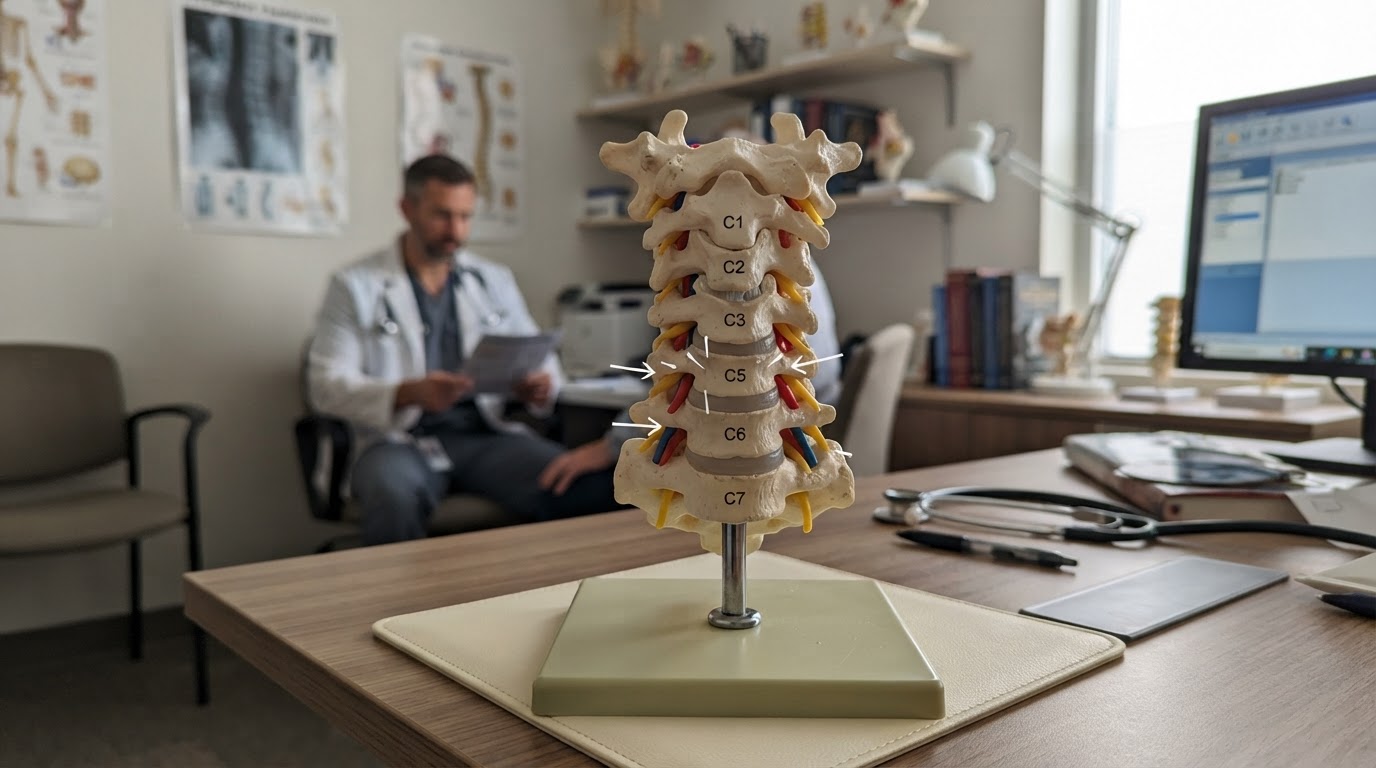
cervical facet syndrome neck joint model showing referred shoulder blade pain paths
You wake up in the morning, attempt to turn your head to check the clock, and are suddenly stopped in your tracks by a sharp, locking pain at the base of your neck. Turning your head to back your car out of the driveway becomes an ordeal requiring you to turn your entire torso. Throughout the day, a deep, persistent, toothache-like ache radiates down into your upper trapezius, across the top of your shoulder, and burrows deep along the inner border of your shoulder blade (scapula). You may even experience throbbing headaches that wrap around the back of your skull to behind your eyes. When patients present to our Windsor clinic with these symptoms, they frequently fear they have a serious disc bulge or torn shoulder rotator cuff. In reality, the true culprit is almost always Cervical Facet Syndrome—a mechanical joint dysfunction that is one of the most common, yet frequently overlooked, sources of chronic neck and referred upper back pain.
Anatomy of the Cervical Facet Joints: The Guiding Hinges of Your Neck
Your cervical spine contains seven vertebrae, and behind the large disc-bearing bodies lies a delicate posterior arch containing paired synovial joints known as zygapophyseal joints—commonly called facet joints. You have two facet joints at every spinal motion segment (one on the left, one on the right), extending from the base of your skull (C1-C2) down to the cervicothoracic junction (C7-T1). These joints are engineered like precision sliding hinges, angled at approximately 45 degrees to allow you to nod, tilt, and rotate your neck smoothly.
Like your knees or hips, each cervical facet joint is a true synovial joint: the opposing bony articular surfaces are coated with ultra-slick hyaline cartilage, enclosed within a fibrous joint capsule, and lubricated by slippery synovial fluid. Crucially, the fibrous joint capsule is densely packed with microscopic mechanoreceptors and nociceptors (pain-sensing nerve fibers) innervated by the medial branch of the cervical dorsal rami. When these joints are jammed, compressed, or irritated, they broadcast intense localized and referred pain signals.
What Causes Cervical Facet Syndrome? Posture, Whiplash, and Degenerative Changes
In a healthy, upright spine with a natural cervical lordotic curve (a gentle C-shaped backward curve), approximately 70% to 80% of your head's gravitational weight is borne by the large vertebral bodies and intervertebral discs, with only 20% to 30% supported by the posterior facet joints. However, modern lifestyles in Windsor—dominated by hours of forward-head desk work, smartphone scrolling, long driving commutes, and physical labor—completely reverse this healthy distribution.
When your head shifts forward by just two to three inches ('forward head posture' or 'tech neck'), the cervical curve flattens. This forces the posterior facet joints into extreme hyperextension and compressive overload, bearing up to 300% more weight than they were designed to tolerate. Over time, the protective hyaline cartilage wears down, synovial fluid dries up, the capsule inflames (capsulitis), and protective muscle spasms lock the joint in place. Other common triggers include sudden whiplash deceleration injuries from motor vehicle accidents and disc height loss that forces adjacent vertebrae closer together.
Understanding Sclerotogenous Referred Pain: Why You Feel It in Your Shoulder Blade
One of the most fascinating and clinically misunderstood characteristics of cervical facet syndrome is the phenomenon of referred sclerotogenous pain. Because the facet joints share embryological nerve pathways with deep muscles and ligaments of the upper back, an irritated facet joint does not just hurt in the neck—it projects pain into predictable distant anatomical zones, mimicking rotator cuff tears, bursitis, or cardiac pain.
C2-C3 Facet Joint: Projects pain upward into the suboccipital region, forehead, temples, and behind the eyes—a primary driver of cervicogenic headaches.
C3-C4 Facet Joint: Refers pain into the posterolateral neck, the middle of the trapezius ridge, and the clavicular area.
C4-C5 Facet Joint: Radiates across the top of the shoulder to the base of the neck, often mistaken for an acromioclavicular (AC) joint sprain.
C5-C6 Facet Joint: Projects deeply into the supraspinous fossa and down along the upper border of the scapula (shoulder blade).
C6-C7 Facet Joint: Projects deep, gnawing pain directly between the shoulder blades (interscapular pain) along the medial border of the scapula, frequently misidentified as a rhomboid muscle strain.
Patients frequently spend months getting deep-tissue massages between their shoulder blades, only for the knot to return the very next morning. Once we identify and adjust the restricted C6-C7 facet joint in the neck, that shoulder blade pain disappears permanently.
Facet Syndrome vs. Herniated Disc: How to Tell the Difference
Differentiating between cervical facet irritation and a cervical disc herniation is essential for selecting the correct therapeutic path:
Movement Provocation: Facet syndrome is aggravated by extending your neck backward and rotating toward the painful side (Kemp's test / facet loading), which pinches the joint. Disc herniations are typically aggravated by flexing the neck forward.
Pain Characteristics: Facet pain is dull, deep, aching, and localized to the neck, shoulder blade, and upper back. Disc radiculopathy is sharp, burning, and shoots past the elbow into the fingers.
Neurological Testing: Facet syndrome exhibits normal deep tendon reflexes, zero dermatomal sensory loss, and full muscle strength. Disc herniations often cause diminished reflexes and finger numbness.
The Chiropractic Solution: Restoring Facet Motion and Eradicating Spasm
Medications such as muscle relaxants and anti-inflammatories only mask the chemical signals; they do not mechanically unlock a physically jammed facet joint. At Active Chiropractic in Windsor, Dr. Annunciato Angelini provides precise, gentle chiropractic adjustments (spinal manipulative therapy) to the restricted cervical vertebrae.
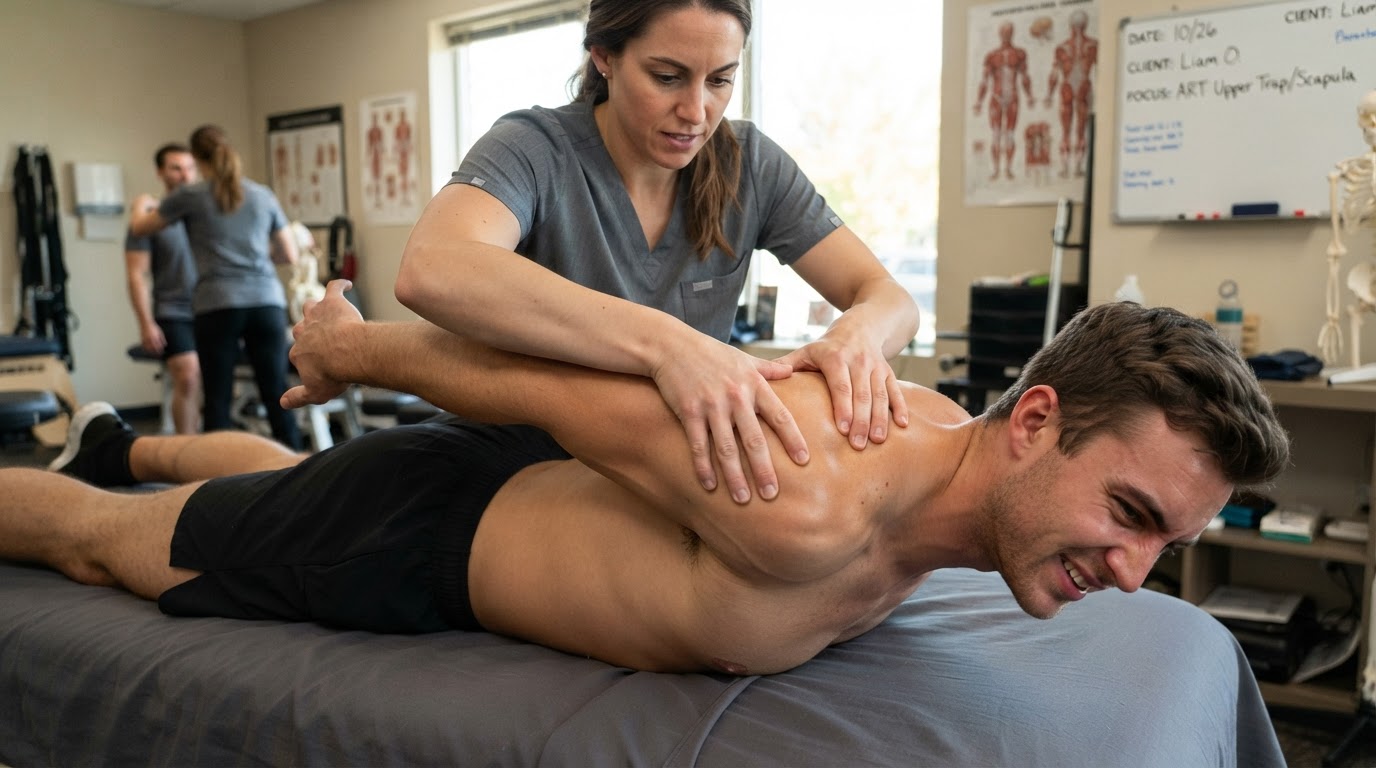
A gentle, high-velocity low-amplitude (HVLA) or light-force instrument adjustment gently separates the articular facet surfaces by a millimeter. This cavitation immediately relieves capsular tension, stimulates type I and II mechanoreceptors that reflexively shut off chronic muscle spasms in the levator scapulae and trapezius, and allows fresh synovial fluid to bathe the articular cartilage. When combined with Active Release Techniques (ART) to clear myofascial adhesions and ergonomic posture retraining, long-term functional recovery is achieved.
Avoid sleeping on your stomach, which forces your cervical facet joints into extreme rotation for hours at a time. Sleep on your back with a contoured cervical pillow, or on your side with a pillow thick enough to keep your neck perfectly parallel to the mattress.
The takeaway
Cervical Facet Syndrome is a primary cause of stiff necks, radiating shoulder blade aches, and tension headaches. Targeted chiropractic adjustments gently unlock the jammed joints, restore fluid mechanics, and eliminate referred pain at the source.
Related Care & Clinic Guides
Explore how our team supports patients recovering from these specific conditions in Windsor:

 Soft Tissue & Sports