Why Your Desk Job Is Quietly Wrecking Your Neck (and How to Fix It)
D
Dr. Mike Paonessa
Chiropractor, Active Chiropractic Windsor
|October 9, 2026 9 min read
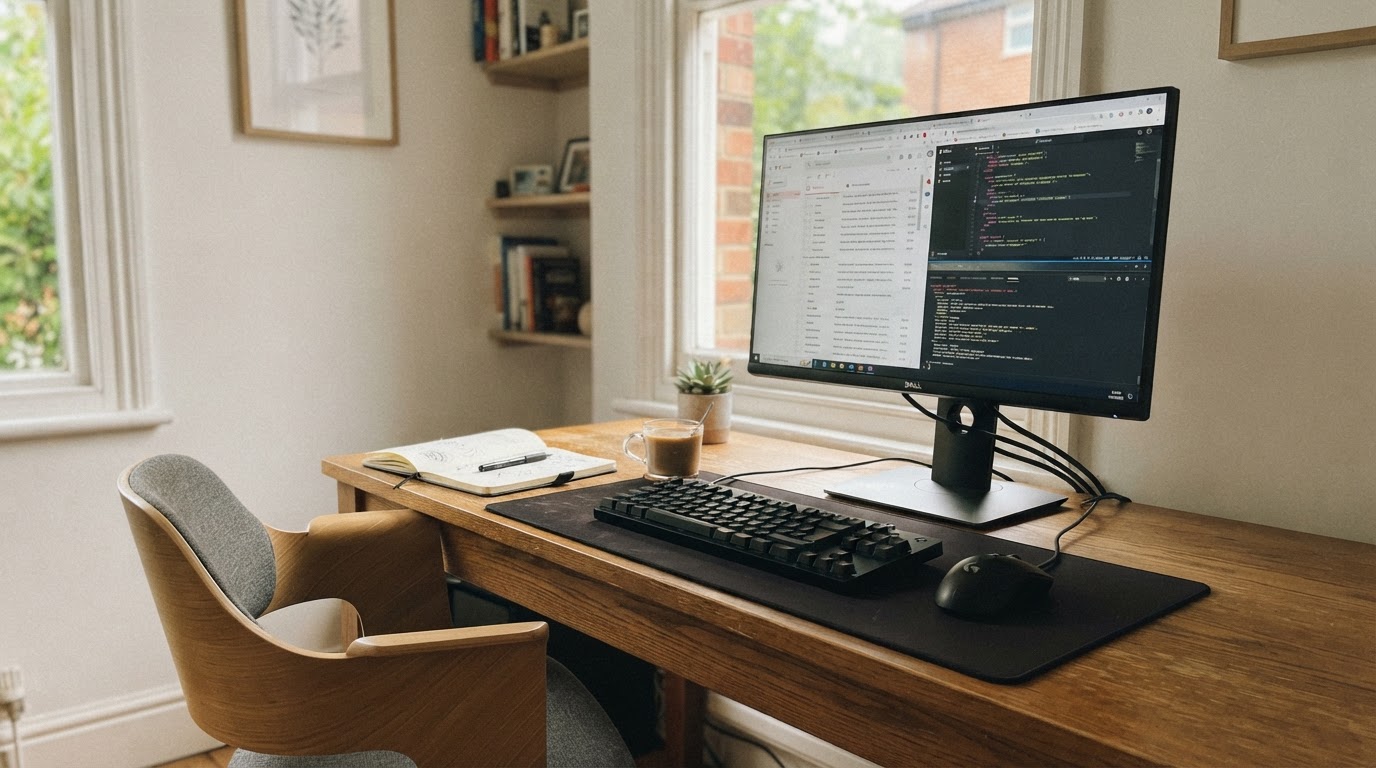
ergonomic desk workstation setup with monitor at eye level for neck pain relief
You sit down at your desk at nine in the morning, look up at the clock, and suddenly it is three in the afternoon. Your neck is stiff, your shoulders have crept up around your ears, and a dull, pressing headache is creeping in from the base of your skull. Sound familiar? You are not alone, and it is not just 'getting older.' Across Windsor and Essex County, desk workers, drivers, students, and anyone who spends hours looking down at a phone or laptop are dealing with the same quiet epidemic. The good news is that once you understand what is actually happening in your neck, the fix is far more straightforward than most people expect. In this guide, we break down the mechanics of desk-related neck pain, the simple changes that make an immediate difference, and when it is time to get hands-on chiropractic care to undo the damage that has built up over months.
The real culprit: 'tech neck' and forward head posture
Your head weighs roughly ten to twelve pounds, about the weight of a bowling ball. In a neutral position, sitting directly on top of your spine, that weight is carried efficiently by your cervical vertebrae and the supporting muscles work very little. But the moment your head starts to drift forward toward your screen, the physics change dramatically. For every inch your head leans forward, you add about ten pounds of effective pressure to your neck. Lean forward two inches, and your neck is now supporting the equivalent of a thirty-pound weight, all day long.
Over an eight-hour workday, that is your neck carrying a small child on top of it, hour after hour. The deep muscles at the base of your skull tire out, the small joints in your neck stiffen and lock up, and the nerves that exit between your vertebrae become irritated. That irritation is exactly where the headaches come from. The pain you feel at the end of the day is not random, it is the predictable result of asking your neck to hold a load it was never designed to carry.
Why the pain builds slowly and then suddenly gets worse
One of the most confusing things about desk-related neck pain is that it creeps up on you. You might feel fine for months, just a little tightness now and then, and then one morning you wake up and you cannot turn your head to back out of the driveway. This happens because the body compensates brilliantly for a long time before it runs out of room. Your muscles tighten to protect the overloaded joints, your posture shifts to take pressure off the sore side, and your nervous system adapts to the new normal. You do not feel the damage accumulating because your body is papering over it.
Eventually, though, the compensations fail. A facet joint that has been jammed for months finally becomes inflamed. A nerve that has been gently irritated for weeks finally flares into a full-blown headache. A disc that has been slowly wearing under uneven pressure finally bulges. This is why so many patients tell us, 'I did not do anything, it just started hurting.' In reality, the injury was building the entire time, and the 'sudden' pain is just the moment the compensation finally broke.
The headache connection: why your neck is causing your head to hurt
Many desk workers are surprised to learn that their recurring headaches are not migraines at all, they are cervicogenic headaches, headaches that originate in the neck. The nerves at the top of your cervical spine connect directly to the nerves that supply the back of your head, your temples, and the area behind your eyes. When the joints and muscles at the base of your skull become restricted and irritated, they refer pain upward into these regions, producing a band-like ache that wraps around your forehead or a throbbing pressure behind one eye.
This is why painkillers often provide only temporary relief for these headaches. The pill dulls the pain signal, but the mechanical irritation in your neck is still there, generating new pain as soon as the medication wears off. Fixing the neck, by restoring normal joint motion and releasing the tight muscles, addresses the headache at its source rather than just muting the symptom.
Three quick fixes you can try today
Before you ever set foot in a clinic, there are simple changes you can make at your desk that take a surprising amount of pressure off your neck. These are not a substitute for care when the problem has been building for months, but they are the foundation of preventing it from coming back once you are feeling better.
Raise your monitor so the top of the screen sits at eye level. If you use a laptop, put it on a stand and use a separate keyboard and mouse so you are not looking down all day.
Pull your chair in close so you do not have to lean forward toward the keyboard. Your elbows should rest near your sides at about ninety degrees.
Set a phone timer for every 30 minutes. When it goes off, stand up, roll your shoulders backward, look up toward the ceiling, and take three slow breaths.
Keep your phone at eye level when reading or texting instead of dropping your chin to your chest, which is the single worst position for your neck.
Support your lower back with a small lumbar cushion so your spine stays in its natural curve, which automatically keeps your head better aligned over your shoulders.
When home fixes are not enough
If your stiffness has been building for months or years, stretching alone often will not undo it. The reason is that the problem is not just tight muscles, it is restricted joints. The small facet joints in your neck, the same joints described in our guide to cervical facet syndrome, can become locked in a restricted position from weeks of poor posture. Once a joint is restricted, no amount of stretching will restore its motion, because you cannot stretch a joint that will not move in the first place.
This is where gentle chiropractic care makes such a difference. A precise, low-force adjustment to the restricted cervical vertebra separates the jammed joint surfaces by a millimeter, restoring normal motion and immediately relieving the capsular tension that has been generating your pain. We pair the adjustment with hands-on soft-tissue work, including Active Release Techniques, to release the chronic muscle tension in your upper traps, levator scapulae, and the deep suboccipital muscles at the base of your skull. Together, these restore both the joint mobility and the muscle flexibility that stretching alone cannot reach.
Most desk workers are genuinely shocked at how much lighter their head feels after one proper adjustment. It is like the tension was a backpack they had been wearing for so long they forgot it was there.
The role of massage and muscle work
Muscles and joints are two halves of the same problem. A restricted joint causes the surrounding muscles to tighten protectively, and tight muscles pull the joint further out of alignment, creating a vicious cycle. Breaking the cycle means addressing both sides. Registered massage therapy is excellent for reducing the general tension and improving circulation in the overworked muscles of the neck and shoulders, while Active Release Techniques targets the specific adhesions, the dense, sticky scar tissue, that build up between muscle layers after months of chronic tightness.
Many of our Windsor patients benefit from a combination approach: chiropractic adjustments to restore joint motion, ART to break down the deep adhesions, and massage to keep the overall tissue healthy and relaxed. The exact mix depends on whether your problem is more joint-driven, muscle-driven, or both, which is something we determine during your first assessment.
Building a neck that does not relapse
The goal of care is not just to get you out of pain once, it is to build a neck that holds up under the demands of your daily life. That means combining hands-on treatment with a few simple strengthening exercises for the deep neck flexors, the small muscles at the front of your neck that are responsible for holding your head in good posture. When these muscles are weak, your head drifts forward and the larger muscles at the back of your neck take over, which is exactly the pattern that leads to pain in the first place.
We teach you a simple chin-tuck exercise that you can do at your desk, along with scapular stabilization work to support your shoulders. These take only a few minutes a day, but they retrain the muscles that keep your head balanced over your spine instead of hanging off it. Combined with the ergonomic changes above, they are what keep the pain from coming back once your joints and muscles have been restored.
Tension headaches that start at the base of your skull and wrap around your forehead are almost always neck-related, not a true migraine. Fixing the neck often fixes the headache. If you have been taking painkillers for recurring headaches for months, it is worth finding out whether your neck is the real source.
The takeaway
Your desk setup and your neck are deeply connected. Small ergonomic changes plus the right hands-on chiropractic care can turn those daily headaches and stiff afternoons off for good, and build a neck that holds up to the demands of your workday.
Related Care & Clinic Guides
Explore how our team supports patients recovering from these specific conditions in Windsor:

 Soft Tissue & Sports