What Is Active Release Techniques (ART)? The Gold Standard Soft-Tissue System for Athletes and Chronic Pain
D
Dr. Annunciato Angelini
Lead Chiropractor, Certified Full-Body ART Provider (23+ Years)
|June 28, 2024 10 min read
what is active release techniques ART certified soft tissue therapy session in Windsor
If you have ever suffered a sports injury, strained a muscle during heavy yard work, or developed chronic stiffness from sitting at a computer all day in Windsor, you know how frustrating it is when pain lingers long after an injury should have healed. You might have tried heating pads, ice packs, general massage therapy, acupuncture, or even steroid shots, only to find that the dull, burning ache returns the moment you resume regular physical activity. The reason conventional treatments so often fail is that they treat symptoms without addressing the underlying physical mechanical pathology: dense myofascial scar tissue adhesions. Active Release Techniques (ART) is an internationally patented, state-of-the-art soft tissue management system designed specifically to evaluate and treat conditions within muscles, tendons, ligaments, fascia, and peripheral nerves. At Active Chiropractic on Tecumseh Road East in Windsor, Dr. Annunciato Angelini has been a certified Active Release Techniques provider for over 23 years, helping thousands of patients break through chronic pain and return to peak functional performance.
The Origins of Active Release Techniques: Developed by a Biomechanical Engineer and Chiropractor
Active Release Techniques was invented in the mid-1980s by Dr. P. Michael Leahy, an aeronautical engineer who later became a Doctor of Chiropractic. While working with world-class Olympic track athletes, triathletes, and NFL football players, Dr. Leahy noticed a consistent pattern: when soft tissues (muscles, tendons, ligaments, and nerves) were injured, they did not simply become 'tight'—they underwent measurable physical changes in tissue texture, tension, and movement relative to adjacent structures.
Drawing upon his engineering background in fluid dynamics and mechanical shearing stress, Dr. Leahy realized that human soft tissue structures are designed to slide effortlessly across one another. When that natural sliding motion is obstructed by fibrotic scar tissue, mechanical friction multiplies exponentially. He developed over 500 specific, patented manual protocols that combine targeted anatomical contact tension with active patient-directed motion to cleave these adhesions apart, restoring natural tissue elasticity and function.
How Does Scar Tissue Form? Understanding the Law of Repetitive Motion
Dr. Leahy formulated a mathematical principle known as the Law of Repetitive Motion: I = N x F / R x A. In simple terms, this states that the degree of internal soft-tissue Insult (I) equals the Number of repetitions (N) multiplied by the Force of each repetition (F), divided by the Rest between repetitions (R) multiplied by the Amplitude of movement (A). When a person performs high-repetition, low-force tasks (like typing on a keyboard or working on an assembly line) with minimal rest, the internal insult climbs rapidly.
Soft tissue trauma typically occurs through three distinct mechanisms:
Acute Trauma: Sudden, high-impact events like muscle tears, sprains, collisions, or whiplash deceleration.
Cumulative Micro-Trauma: Thousands of repetitive sub-maximal contractions without adequate recovery, such as marathon running, distance cycling, or factory production line tasks.
Constant Postural Tension & Hypoxia: Holding static postures (such as sitting with forward-head posture) for hours, which compresses micro-capillaries and deprives muscle tissue of vital oxygen.
Under oxygen-deprived (hypoxic) conditions, the body initiates a rapid repair response by dispatching fibroblasts to synthesize dense, disorganized collagen fibers. This scar tissue acts like superglue between neighboring muscle bellies, fascial layers, and peripheral nerves. As scar tissue proliferates, the muscle becomes shorter, weaker, and less flexible. The tight muscle puts abnormal tension on its tendon origins, leading to chronic tendinitis, while the reduced joint motion leads to premature wear and tear on spinal discs and cartilage.
How Does an ART Treatment Actually Work?
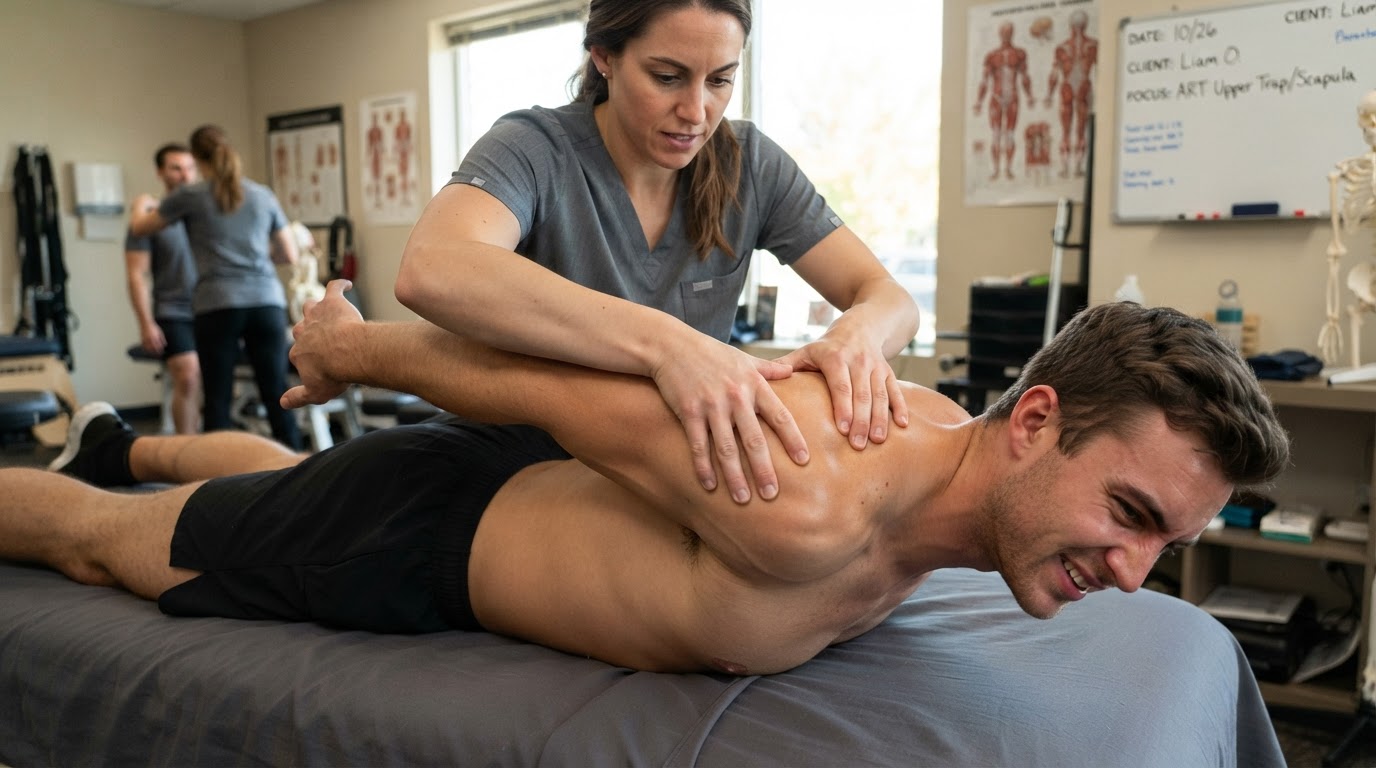
Active Release Techniques is not a massage, nor is it a passive physical therapy modality. Every ART session is a dynamic combination of continuous hands-on evaluation and treatment. Dr. Angelini uses his hands to evaluate the texture, tightness, and movement of your muscles, fascia, tendons, ligaments, and nerves.
Once an adhesion is identified, Dr. Angelini places a precise, directional manual tension with his fingers or thumb directly over the restrictive lesion while the muscle is in a shortened position. He then instructs you to actively move the corresponding limb or body part so the muscle lengthens fully beneath his contact. As the tissue slides under his tension vector, the dense collagen cross-links are physically sheared apart. By the end of the session, the muscle can stretch and contract without internal drag, immediately restoring full range of motion and relieving joint stress.
Clinical Conditions That Respond Exceptionally Well to Active Release Techniques
Plantar Fasciitis: Breaking down fibrotic adhesions in the plantar fascia, Achilles tendon, and deep calf muscles (soleus and gastrocnemius) to eliminate agonizing morning heel pain.
Rotator Cuff & Shoulder Impingement: Restoring normal glide between the supraspinatus, infraspinatus, subscapularis, and deltoid muscles so the arm can lift smoothly without pinching.
Tennis Elbow & Golfer's Elbow: Clearing scar tissue from the extensor carpi radialis brevis and flexor tendons on the lateral and medial epicondyles of the elbow.
Sciatica & Piriformis Syndrome: Freeing the trapped sciatic nerve where it passes beneath or through the hypertonic piriformis muscle in the buttock.
Carpal Tunnel Syndrome: Releasing median nerve entrapment in the pronator teres, flexor digitorum superficialis, and transverse carpal ligament in the wrist.
Chronic Headaches & Neck Stiffness: Clearing adhesions in the suboccipital triangle, levator scapulae, and upper trapezius to eliminate cervicogenic headaches and 'tech neck'.
Active Release Techniques is used in every NHL locker room, NFL training facility, and at the Ironman World Championship in Kona for one simple reason: it fixes soft-tissue injuries faster and more completely than anything else.
Why Certified ART Providers Stand Out
Becoming a certified Active Release Techniques provider requires hundreds of hours of intensive anatomical study, hands-on biomechanical training, and rigorous practical credentialing examinations. Providers must master the exact anatomical fiber direction, origins, insertions, and peripheral nerve pathways of every structure in the body. Dr. Annunciato Angelini maintains full certification, ensuring that your treatment is delivered with the highest level of anatomical precision.
Wear loose, comfortable athletic clothing (such as shorts and a T-shirt or tank top) to your ART appointments so your limbs can move through full active ranges of motion without fabric restriction.
The takeaway
Active Release Techniques is the world's premier soft-tissue management system. By directly breaking down restrictive scar tissue adhesions and releasing trapped peripheral nerves, ART restores true tissue glide, eliminates chronic pain, and gets you back to the activities you love.
Related Care & Clinic Guides
Explore how our team supports patients recovering from these specific conditions in Windsor:
 Soft Tissue & Sports