Hip Bursitis (Greater Trochanteric Pain Syndrome): Why Injections Keep Failing and How Chiropractic Heals It
D
Dr. Annunciato Angelini
Lead Chiropractor (23+ Years Clinical Practice)
|May 24, 2024 9 min read
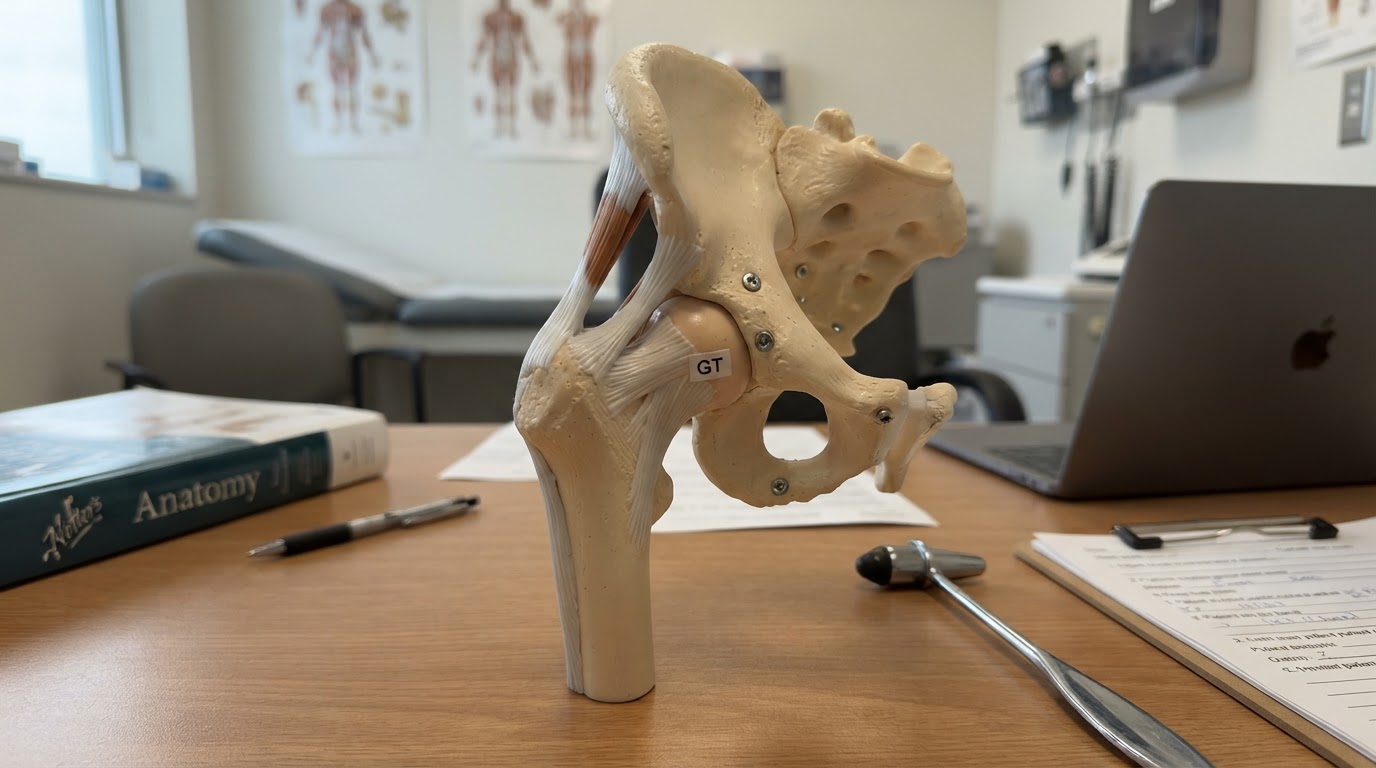
hip bursitis and greater trochanteric pain syndrome hip joint anatomical model
Do you find yourself tossing and turning at night because lying on your side sends a sharp, throbbing ache radiating through your outer hip? Does getting up from a low chair, climbing a flight of stairs, or walking more than a few blocks make your hip feel stiff, bruised, and agonizingly tender to the touch? If you have visited a physician for these symptoms, you were likely diagnosed with 'trochanteric bursitis' (or subtrochanteric bursitis) and offered a temporary cortisone shot. Yet, for thousands of patients across Windsor and Essex County, cortisone injections provide relief for only a few brief weeks before the deep, throbbing hip pain returns worse than before. Why does this happen? Because modern orthopedic science has revealed that 'bursitis' is rarely an isolated problem—it is almost always part of a broader mechanical disorder called Greater Trochanteric Pain Syndrome (GTPS). At Active Chiropractic in Windsor, Dr. Annunciato Angelini resolves the true biomechanical roots of outer hip pain using certified Active Release Techniques (ART), pelvic realignment, and gait correction.
Anatomy of the Lateral Hip: The Greater Trochanter, Bursae, and Gluteal Tendons
To understand why hip pain develops, we must examine the lateral (outer) hip architecture. The prominent bony landmark you can feel on the side of your upper thigh is the greater trochanter of the femur. Serving as a massive anatomical hub, the greater trochanter is where powerful stabilizing muscles attach—principally the gluteus medius and gluteus minimus tendons, which are responsible for keeping your pelvis level whenever you stand on one leg during walking or running.
Overlying these tendons and the bony trochanter is the iliotibial band (IT band)—a thick, fibrous strap of connective tissue running from your hip down to your knee. To prevent friction between the moving IT band, the gluteal tendons, and the bone, your body places small fluid-filled friction pads called bursae (principally the trochanteric bursa and the subgluteal bursae). In a healthy hip, these bursae allow the tendons and IT band to glide smoothly like oiled silk.
The Modern Medical Paradigm Shift: From 'Bursitis' to Gluteal Tendinopathy
For decades, outer hip pain was assumed to be an acute primary inflammation of the trochanteric bursa. However, extensive high-resolution ultrasound and MRI studies conducted over the past fifteen years have revolutionized our clinical understanding. Radiologists found that isolated inflammation of the bursa is present in less than 20% of symptomatic patients! Instead, the true primary pathology in over 80% of cases is gluteal tendinosis or tendinopathy—degenerative micro-tearing and collagen breakdown within the gluteus medius and minimus tendons.
When the gluteus medius tendon becomes weakened, frayed, and overloaded, it inflames and thickens. The overlying IT band compresses the swollen tendon against the bone with every step. The adjacent bursa only inflames secondarily as an innocent bystander caught in the crossfire of severe mechanical friction. This explains why cortisone injections into the bursa fail over the long term: cortisone temporarily numbs the bursa, but it actually weakens collagen fibers in the already frayed gluteal tendons, accelerating long-term tendon degeneration.
Root Causes: What Triggers Gluteal Overload and Lateral Hip Friction?
Trendelenburg Gait & Gluteal Inhibition: When the deep gluteus medius is weak, your opposite hip drops every time you take a step. This excessive pelvic tilt puts the weight-bearing hip into extreme adduction, violently stretching and compressing the gluteal tendons against the trochanter.
Pelvic Torsion & Sacroiliac Joint Subluxation: A rotated pelvis or locked SI joint alters the physiological tracking of the hip socket, increasing continuous tensile strain on the lateral hip rotators.
Tight Iliotibial (IT) Band & Tensor Fasciae Latae (TFL): A shortened, fibrotic IT band acts like a tight guitar string snapped across the greater trochanter, creating brutal compressive shear with every stride.
Crossed-Leg Sitting and Sleeping Postures: Sitting with your legs crossed, or sleeping on your side with the top knee dropping forward across the body, places the gluteal tendons in prolonged compressive tension for hours.
Leg Length Discrepancy & Foot Overpronation: Flat feet (fallen arches) cause internal rotation of the shin and thigh, torqueing the hip joint and overworking the lateral stabilizers.
Cortisone shots are a temporary chemical bandage. If your pelvis is torqued and your IT band is rubbing like a cheese grater against your hip, the pain will always return until the mechanics are corrected.
Our Non-Surgical Clinical Approach at Active Chiropractic in Windsor
At our Windsor clinic on Tecumseh Road East, Dr. Annunciato Angelini treats hip pain through a comprehensive biomechanical restoration protocol:
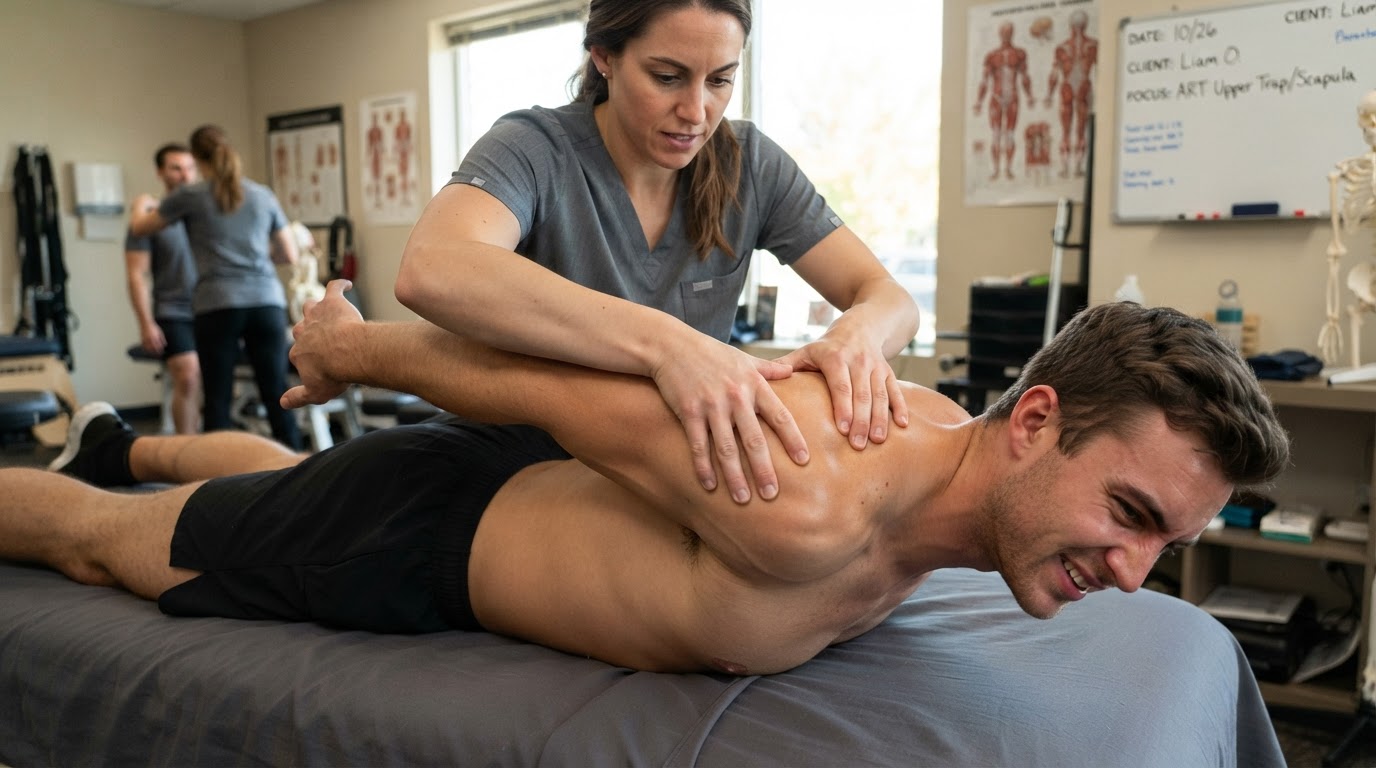
Active Release Techniques (ART): Releasing dense scar tissue and restoring elasticity to the gluteus medius, gluteus minimus, piriformis, tensor fasciae latae, and iliotibial band.
Chiropractic Pelvic & Sacroiliac Adjustments: Restoring symmetrical alignment and motion to the pelvis and lumbar spine, eliminating abnormal hip adduction shear.
Isometric & Eccentric Gluteal Rehabilitation: Prescribing targeted, pain-free isometric loading exercises that stimulate tenocytes to lay down fresh, organized type I collagen.
Custom Orthotic Gait Correction: Evaluating your arches and gait biomechanics to eliminate internal tibial rotation and kinetic collapse from the ground up.
Sleep Posture & Ergonomic Coaching: Teaching side-sleepers how to position specialized contour pillows between the knees and ankles to keep the hip in a neutral, non-compressed vector.
If you sleep on your side, always place a firm pillow between your knees and down through your ankles. This keeps your top leg parallel to the bed and completely prevents the painful compressive stretch on your outer hip tendons throughout the night.
The takeaway
Persistent outer hip pain is rarely simple bursitis—it is Greater Trochanteric Pain Syndrome driven by pelvic torsion and gluteal tendon overload. Chiropractic alignment and Active Release Techniques fix the friction at the source for permanent, drug-free relief.
Related Care & Clinic Guides
Explore how our team supports patients recovering from these specific conditions in Windsor:

 Soft Tissue & Sports