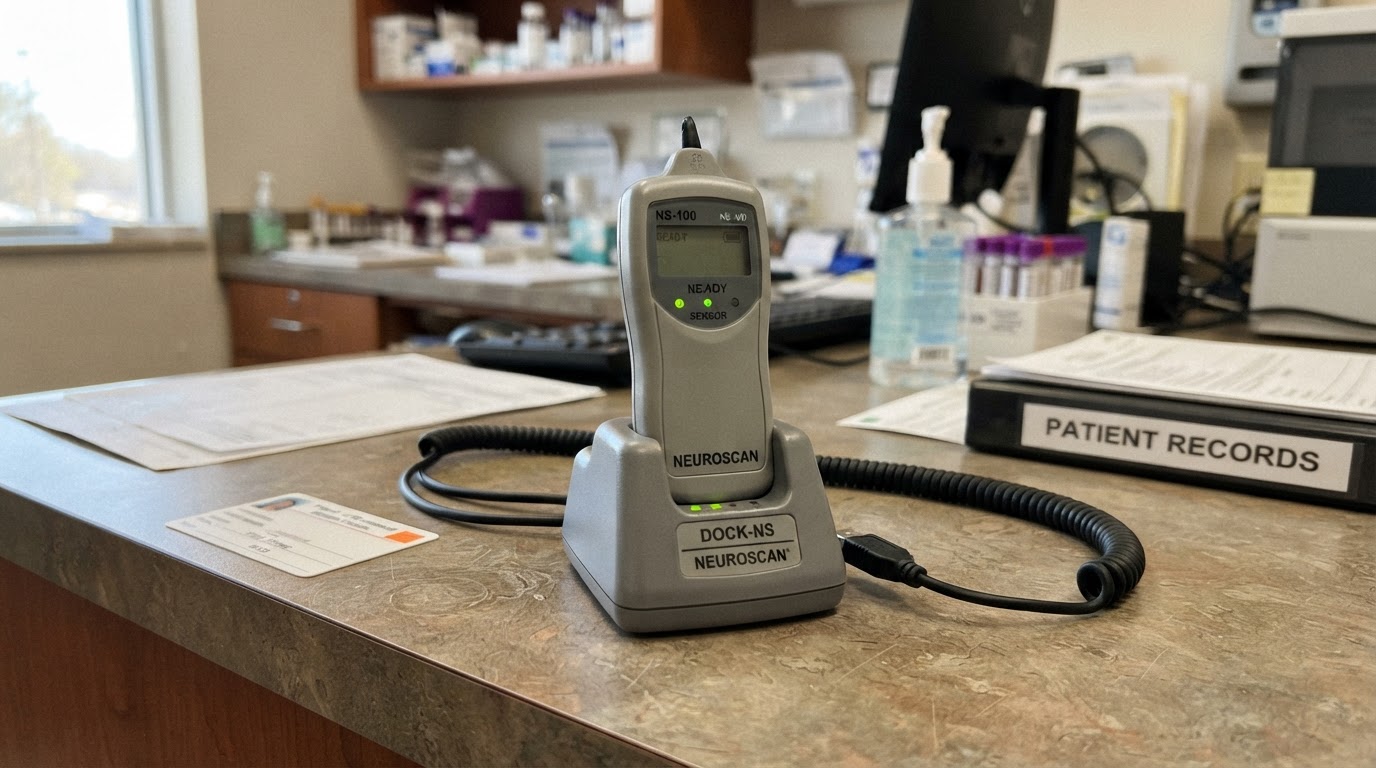
diagnostic computerized nerve scanner device on clinic docking station in Windsor
Two people can walk into our Windsor clinic with the exact same lower back pain and need completely different care. One might have a disc herniation pressing on a nerve, the other might have a restricted joint referring pain into the leg, and a third might have a muscle imbalance that is overloading the spine. Treating all of them the same way would help some and frustrate others. That is why, at Active Chiropractic, we do not guess, we scan. Computerized nerve scanning is one of the most valuable tools in our clinic because it lets us see exactly where your nervous system is under stress, often before you can feel it, and it gives us a measurable way to prove your healing over time. In this guide, we explain what that little device is actually telling us, how the technology works, and why it changes the way we build your care plan.
What the scan actually measures
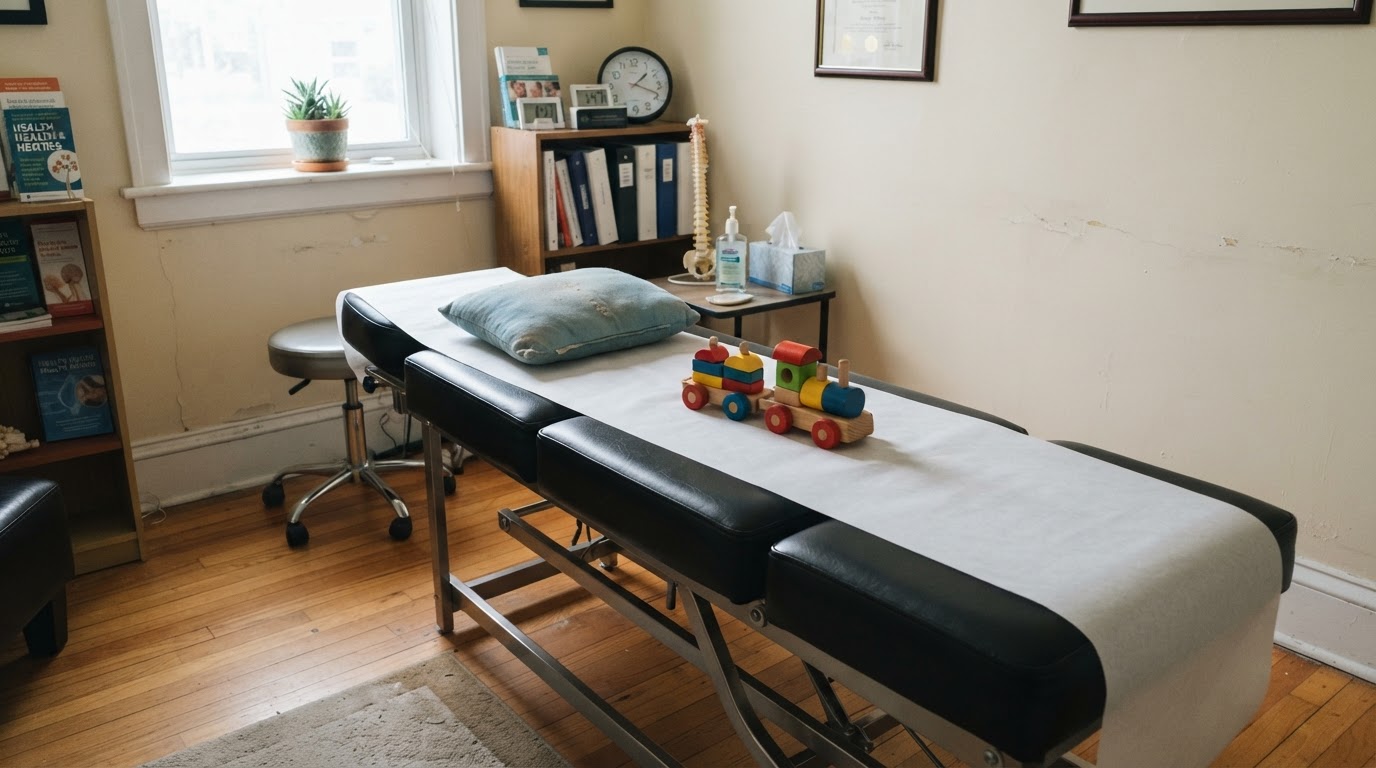
We run a small, handheld sensor gently along your spine, from your neck down to your lower back. The whole process takes about two minutes and is completely painless, there are no needles, no electricity passing through you, and no discomfort. As the sensor moves, it picks up two distinct signals at each spinal level, and together those signals tell us a remarkably detailed story about how your nervous system is functioning.
The first signal is surface electromyography, or sEMG. This measures the tiny electrical activity in the muscles along your spine. When a spinal joint is restricted or a nerve is irritated, the muscles on either side of that level tighten protectively, and that tension shows up as increased electrical activity on the scan. A healthy spine shows balanced, low muscle tension on both sides. An area under stress shows a clear spike, often on one side, telling us exactly which level is working overtime to protect an underlying problem.
The second signal is thermal scanning, which measures small temperature differences along your spine. This is not about feeling hot or cold to the touch, it is about the autonomic nervous system, the part of your nervous system that automatically controls blood flow, organ function, and healing. When a nerve is irritated at a particular spinal level, it disrupts the normal autonomic regulation of blood vessels in the skin nearby, creating a subtle temperature asymmetry. The thermal scan detects these patterns, giving us a window into how your autonomic nervous system is coping with stress at each level.
Why seeing muscle tension and temperature together matters
Each signal on its own is useful, but the combination is what makes nerve scanning so powerful. Muscle tension tells us about the somatic, or voluntary, side of your nervous system, the muscles that are guarding and protecting an injured area. Temperature tells us about the autonomic side, the involuntary control of blood flow and healing that is influenced by nerve irritation. When both signals light up at the same spinal level, we have strong evidence that the nerve roots exiting there are under real stress, not just that a muscle happens to be tight.
This matters because muscle tightness alone can come from many things, a tough workout, a poor night of sleep, a stressful day. But when that tightness lines up with an autonomic temperature pattern at the same level, it points to a deeper neurological component. That distinction shapes your entire care plan. A purely muscular problem might respond well to massage and stretching, while a nerve-root irritation often requires gentle spinal alignment or decompression to relieve the pressure on the nerve itself.
Why this matters: catching problems before you can feel them
Here is something that surprises many patients: you cannot feel a pinched nerve until it is bad enough to cause pain. The nervous system has a huge reserve capacity, and a nerve can be under significant stress, losing conductivity and irritating the tissues it supplies, long before you feel anything at all. By the time pain shows up, the underlying problem has often been developing for weeks, months, or even years.
This is exactly how someone can have a bulging disc visible on an MRI and feel completely fine, while another person with a smaller bulge is in agony. The difference is not just the size of the bulge, it is how much functional stress the nerve is under. The scan catches that functional stress early, sometimes before you feel a thing, which means we can address a developing problem before it turns into a painful crisis. For patients coming in with a specific complaint, the scan helps us find the contributing problems you did not even know you had.
Finds nerve stress before it becomes painful, often revealing issues you cannot feel yet
Shows exactly which level of the spine is under the most stress, taking the guesswork out of where to focus care
Distinguishes between a muscular problem and a deeper nerve-root problem, which require different treatment
Gives us a measurable score to track your healing objectively, visit by visit
Takes about two minutes and is completely painless, with no needles or discomfort
Turning 'I think I feel better' into proof
Perhaps the most valuable thing about nerve scanning is what it does after your care begins. Pain is subjective, it comes and goes, and it is influenced by sleep, stress, mood, and activity. When you are in the middle of a care plan, it can be hard to know whether you are genuinely improving or just having a good day. The scan removes that uncertainty.
When you come back for your follow-up visits, we re-scan your spine and compare the results to your baseline. As your nervous system heals, the muscle tension at the irritated levels drops and the temperature patterns normalize. We can show you, in numbers and in color, that the stress on your spine is actually decreasing. This is incredibly motivating for patients, especially those who have been in pain for a long time and had started to wonder whether anything was really changing. It also tells us, objectively, when a particular approach is working and when we need to adjust your plan.
Patients love seeing their scan improve visit by visit. It turns 'I think I feel a little better' into 'here is the proof I am healing.' That shift, from hoping to knowing, changes everything about how people engage with their care.
How nerve scanning fits into your first visit
At Active Chiropractic, we include a computerized nerve scan in your very first visit, at no extra cost. It is part of how we make sure your care plan is built on facts, not guesses. Your first appointment begins with a conversation about your history and your goals, followed by a hands-on examination of your spine, your posture, and your range of motion. The nerve scan adds an objective layer to that examination, showing us the functional state of your nervous system in a way that neither conversation nor hands-on assessment alone can reveal.
From there, we put all of that information together to build a care plan that is specific to you. Two people with the same complaint might receive different care because their scans tell different stories about what is actually happening in their spines. And because we re-scan throughout your plan, your care evolves as your body heals, rather than staying locked into a one-size-fits-all protocol.
Is nerve scanning safe for everyone?
Yes. Because the scan is completely non-invasive and passive, simply reading signals your body is already producing, it is safe for patients of every age, from children to seniors. There is no radiation, no electrical current applied to the body, and no risk of making an existing problem worse. It is equally useful for a competitive athlete looking to optimize performance, a desk worker trying to understand recurring headaches, and a senior managing the stiffness of an aging spine. The only thing the scan requires is that you sit still for about two minutes, which is a small price for the clarity it provides.
We include a nerve scan in your very first visit, at no extra cost. It is part of how we make sure your care plan is built on facts, not guesses. If you have been told your pain is 'just stress' or 'just getting older,' a scan can show you exactly what is really going on.
The takeaway
A two-minute, painless nerve scan turns your care from guesswork into measurable progress. By seeing where your nervous system is under stress, often before you can feel it, and tracking that stress as it decreases, we can build a care plan that is precise, personal, and provably effective. That is how real healing gets proven, not just promised.
Related Care & Clinic Guides
Explore how our team supports patients recovering from these specific conditions in Windsor:

 Soft Tissue & Sports